
CONCEPT AND APPLICATION SHEET
Board game "My Inner Team"
A visualizing board game for
resource activation, conflict resolution and
promotion of emotional self-regulation
My Inner Team
1. Pedagogical Concept
Making inner processes visible – playful understanding of personality parts
“My inner team” is a deeply effective reflection game that helps pedagogical professionals
to talk with children, adolescents, and adults about inner conflicts, strengths, and blockages.
Players choose characteristics as team members, set up opponents, and reflect on their inner dynamics in the sense of a systemic-
solution-oriented attitude.
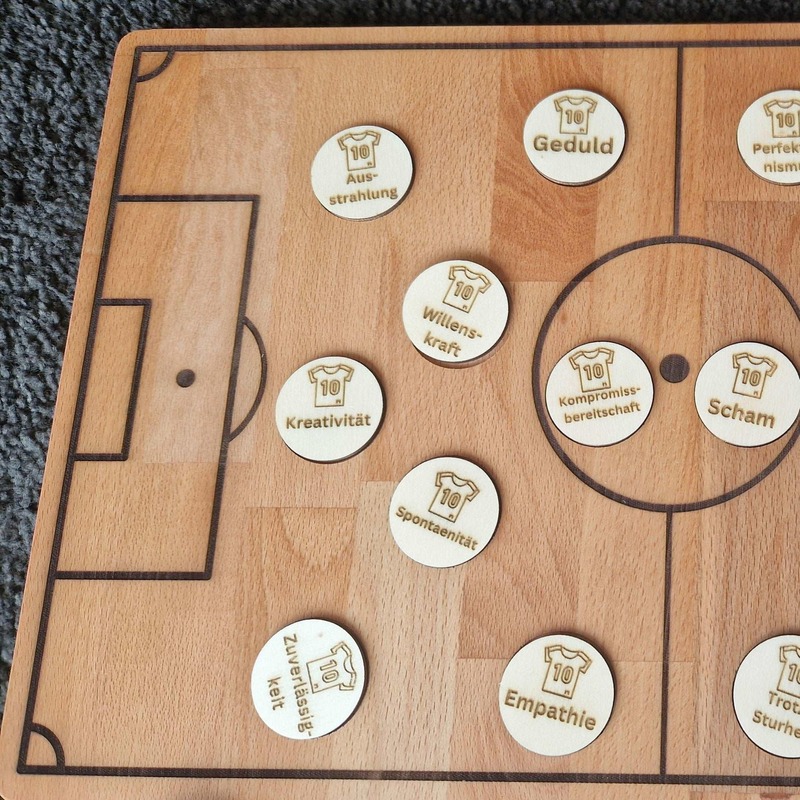
The football field look of the game board opens up an appealing metaphor: life as a game –
with lineup, strategy, captain, opposing team, and training plan. The game approach creates
emotional distance with simultaneously high self-commitment – ideal for people with low
frustration tolerance, speech inhibition, or complex inner conflicts.
The game is not rigid – it can be changed over time, just as (self-)
perception changes and development happens.
2. Why the game works in a pedagogical context
reflection-promoting – structures inner parts and facilitates self-understanding
solution-oriented – promotes resource activation instead of problem focus
systemically compatible – supports counseling, promotion & goal work
playful and low-threshold – especially helpful in residential, school, and counseling
contexts
The difference to classic tools like cards or scales:
While reflection cards often provide visual impulses, the board game creates a haptic,
interactive, and dynamic process. It's not just about selection, but about
positioning, role distribution, and strategies – using terms from team sports: captain,
substitute bench, lineup, training.
My Inner Team
3. Game content at a glance
1 high-quality wooden playing field with a soccer field look
52 coins with terms related to strengths/competencies/blockages & challenges:
Dependency, Fear, Adaptability, Open-mindedness, Charisma, Resilience,
Discipline, Perseverance, Jealousy, Egoism, Initiative, Empathy, Leadership,
Patience, Faith, Helpfulness, Humor, Intelligence, Intuition, Physical Strength,
Compromise, Creativity, Critical Thinking, Distrust, Motivation, Courage, Openness,
Sociability, Optimism, Organizational Skills, Perfectionism, Pessimism,
Consideration, Risk-taking, Shame, Self-confidence, Independence,
Self-reliance, Self-defense, Self-efficacy, Spontaneity, Sportiness, Pride,
Structure, Teamwork, Tolerance, Stubbornness, Persuasiveness, Independence,
Restlessness/Impatience, Trust, Fear of Loss, Fear of Failure, Willpower, Reliability
-
6 playing cards with targeted reflection questions:
Who is the strongest player from the opposing team? Which of your players could
weaken them?Which of your competencies/strengths form your strongest team?
Who is your team captain and thus the most important key player?
What dream team would I create in the future to tackle my future with it?
Who is on your opposing team? Who do you have to compete against?
Which team/which players would I need to overcome a current problem?
Areas of application
Youth Welfare & Residential Groups
School Social Work
Coaching & Career Guidance
Psychotherapy & Trauma Pedagogy
Family Support & Couples Counseling
Disability Care, Elder Care, Biographical Work
4. Application Recommendation (Short Version)
Quick Start for Professionals – just like a real game:
Warm-up: Prepare board and coins – introduction to the setting
Line-up: Participant chooses 6–8 coins for their own team (strengths)
Opponent analysis: Then 3–6 coins for the opposing team (blockades)
Appoint captain: Who is currently calling the shots? Who should lead?
Game analysis: Use reflection cards – link players, find counter-arguments
Create training plan: What should be strengthened, what should be brought in?
Evaluation: Make insights visible – e.g., drawing, writing, speaking
My Inner Team
Further application ideas (bullet points):
Strengthening and visualising one's own abilities & resources
Reflection on weaknesses, hurdles, worries & fears
Problem analysis: Who or what is disturbing, hindering, blocking?
Pro & contra setup: Positive vs. burdensome aspects
Goal setting & dream team: Which players do I need for my goal?
Team analysis & group dynamics: How do I see myself – how do others see me?
Case study 1: Youth welfare – working with a 12-year-old boy
A 12-year-old boy from a residential facility appears very
tense internally. He often withdraws, avoids group activities, and frequently reacts
with resistance to new offers. In a supervised individual setting with the
board game "My Inner Team," he initially hesitates, but then decides to assemble
his own team from the coins of Courage, Perseverance, Creativity,
Self-confidence, Humor, Agency, Team Spirit, and Intuition. He chooses Courage as captain.
His opposing team consists of fear of failure, anxiety, dependence, shame and
mistrust. In his reflection, he initially names "fear" as a paralyzing opponent that often
prevents him from doing things. But in conversation with the specialist, he begins to
realize that his fear sometimes also protects him – e.g. from being laughed at again, as
he was in school. "Fear actually only wants to protect me," he finally says.
This realization initiates a process of re-evaluation: Fear remains in the opposing team,
but is no longer seen as an enemy, but as a warning signal that can also be useful. The
specialist uses this image to develop a training plan with him: How can courage work
with fear? Who from the bench – such as self-confidence or intuition – could help take
responsibility at the right moment.
Case Study 2: Mother-Child Work – Burdened Mother Reflects on Family Dynamics
A 38-year-old single mother comes for coaching because she is increasingly clashing
with her 10-year-old son. She describes herself as "constantly tense, irritable, and at the
same time helpless." School, everyday life, emotional issues – everything feels like too
much. The conversation reveals that she places very high demands on herself but has
little time for herself.
With the help of the "My Inner Team" game, she sets up her own team: patience, clarity,
self-efficacy, charisma, intuition, discipline, empathy, and responsibility. She names
responsibility as the captain – she says: "I feel like I have to carry everything alone."
In the opposing team, she chooses overwhelm, self-doubt, anger, mistrust, and
perfectionism. During the reflection, it becomes clear how deep the pain runs: "I just
function. I always feel like I'm not enough." She begins to cry when she talks about the
"perfectionism" coin: "I don't want to be the perfect mother – I just want to be seen."
My Inner Team
Together with the specialist, she develops a new perspective on some of her
opponents: Mistrust, she realizes, protects her from being hurt again – even in
contact with herself. She draws up a training plan in which patience and
self-efficacy get regular playing time. She deliberately puts self-doubt
on the bench, with the goal of trusting herself more often in the future. The captain
remains responsibility – but no longer in an exaggerated form, but as a
self-determined force.
5. Application Recommendation (Long Version)
Application variants at a glance – process-oriented & creatively usable:
Strengthening & visualization of own abilities and resources
Players set up their inner team, choose 6-8 strengths and competencies
Target: Promote self-awareness, recognize strengths, strengthen self-identity.Development & reflection of weaknesses, hurdles & worries
Define opponents: Which inner parts block? What causes fear? Who
stands in the way? Goal: Dealing with burdensome parts.Problem analysis with current or past conflict
The players describe a concrete problem. Then it is made visible:
Which coins hinder? Who in the team can support? Which players are missing?Pros and cons analysis
Division into strengthening and inhibiting parts – strengths vs. blockages. Visualized
is an inner dialogue between both sides.Goal and wish alignment
Participants consider: What dream team do I need to achieve my goal?
Which players are still missing? Which ones should go to training?Group & Team Analysis
Mutual lineup: How do others see me? Which players do they assign to me?
What makes our team strong? What is missing from our group?
Note: Experienced professionals can freely introduce the game and allow the process to unfold. With confident handling, the game can also start without instructions – what develops from it arises in the moment.
How?
Introduction: Invitation to "Team Setup" - Which players belong to
your inner team?Select players: Define your own team members + opponents (Strengths vs.
Blockages)Name captain: Who is currently leading? Who should lead?
Use reflection cards: Develop solution ideas, target picture, counter-strategies
Training plan: Which players need more playing time? Who goes to the
bench? Which strengths need training?Ask transfer questions: What do you take away? What can you specifically
use tomorrow?Create visibility: Record players, document in portfolio, reflect
When?
In individual consultations, group lessons, support settings
In social skills training, conflict resolution, coaching
During transitions, decision-making processes, goal definitions
In-depth game application - attitude, conversational skills & transfer work
The game unfolds its full potential when it is understood not as a "tool" but as an invitation
to self-discovery. Important is an accompanying attitude of genuine
curiosity, openness, and trust in the process capabilities of the child or
adolescent.
Use player roles purposefully – pedagogical meanings:
Striker: The striker stands for active solution strategies, courage, and
goal orientation. He symbolizes parts that push forward, want to achieve goals,
and bring energy into implementation. Question: "Which of your players goes
on the offensive?"Goalkeeper: The goalkeeper protects their inner self. They stand for emotional stability,
boundaries, and protection. Often, they are a symbol of self-care, demarcation, or
resilience. Question: "What helps you protect yourself or fend off things?"Defenders: These roles keep opponents at bay. They represent inner
defense mechanisms, structure, vigilance, or strategies for
problem-solving. Question: "Who defends your team against blockages?"Team Captain: Mirrors current life reality - who is (consciously
or unconsciously) currently leading internally?Substitute Bench: Represents uncertainties, ambivalences, and development potential -
what should perhaps come into play soon?Training Plan: Symbolizes areas for growth - what needs strengthening? Which
skills need to work better together?Professionals should not interpret too quickly, but first ask questions:
"What does this characteristic do to you?", "Why is this player important?"Especially with adolescents facing multiple burdens, working with the game
over several sessions can build trust and lead to long-term
change.
My Inner Team
Let's make the world
a more understandable place
together!
Vanessa & Matthias
from LiLea